
Your First 0.001 BTC: A Hashrate Timeline With Real Numbers
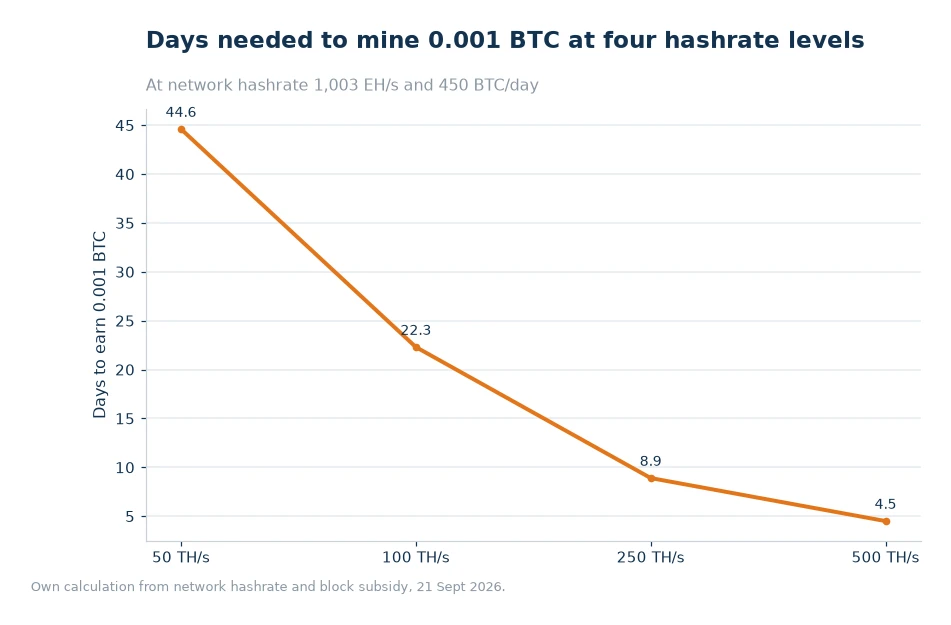
One thousandth of a bitcoin is worth $84.69 at $84,692 per BTC, which makes it a useful first milestone: small enough to reach, large enough to prove that a machine, a connection and a payout method all work together. At 50 TH/s it takes 44.6 days at a network hashrate of 1,003 EH/s. At 500 TH/s it takes 4.5 days. Between those two rows sits every reasonable first rig.
Key takeaways
- 50 TH/s mines 0.00002243 BTC a day, so 0.001 BTC arrives in 44.6 days; at 500 TH/s the wait is 4.5 days.
- The target is worth $84.69 gross at $84,692 per BTC, or $81.30 after the listed 4% on the block-reward component.
- Pool Hashrate decides how often blocks arrive; Pool Luck measures the gap between found and expected blocks.
- A −2.12% difficulty estimate would shorten each timeline by roughly 2.2% if it lands.
Why a small target is the right first test
A first payout is an integration test. It proves that the power supply holds under load, that the network link is stable enough to keep submitting shares, that the payout address is correct, and that the settlement rules behave as described. Waiting 44.6 days for that confirmation at 50 TH/s is slow but economical. Waiting four and a half days at 500 TH/s is faster and costs ten times as much in hardware. Either way, the milestone is about verification before volume, not about the $84.69.
The number also has a practical use as a threshold. Some miners set a payout address once and then wonder why nothing arrives; a target makes the expected arrival date explicit, so a missing credit becomes a question with a date attached rather than a vague worry. Write the date down when the machine starts, then compare it with the balance when the day arrives. If the balance is short by a wide margin, the cause is usually a dead board or a wrong address, not a pool arithmetic problem.
The one rate behind all four rows
Bitcoin issues 3.125 BTC per block across 144 blocks a day, which is 450 BTC for the whole network. Divide that by the network hashrate of 1,003 EH/s, or 1,003,000,000 TH/s, and each terahash is worth 0.00000044865 BTC a day. Multiply by your hashrate for a daily figure, then divide the target by that figure. There is no third step, and no pool-specific constant enters until the listed fee is applied.
That is worth stating plainly because pools are often described as though they change the rate. They do not. A pool changes when and how the output is paid, and what percentage is deducted, but the quantity of coins the network issues per unit of hashrate is set by protocol and by everyone else's machines. A miner comparing two pools is comparing settlement cadence and listed rates, not the size of the underlying slice. The slice is identical, which is why a pool review that promises more coins per terahash is describing luck, not arithmetic.
Pool Hashrate, Pool Luck and a four-day window
The state page for the ViaBTC BTC Mining Pool shows the pool's hashrate and a luck reading beside the network totals. At a four-and-a-half-day horizon those numbers matter more than they do over a year, because there is less time for randomness to average out. Pool Hashrate tells you how many blocks the pool expects to find in that window; Pool Luck tells you how many it actually found.
For a PPS+ miner the distinction is academic, since settlement runs hourly against difficulty and the balance grows regardless of block discovery. For a PPLNS miner it is not: settlement waits for 6 confirmations and shares out real rewards across the last 5 difficulty rounds, so a short run can finish above or below the model without anything being broken. A first milestone planned on PPLNS should carry a few days of slack for exactly this reason.
The four timelines, side by side
The table keeps the daily rate fixed and varies only the hashrate, so the days column scales inversely. The dollar column shows the gross value of a day's output at $84,692, which is the fastest way to see whether a machine's power cost fits underneath it.
| Hashrate | BTC per day | Days to 0.001 BTC | Gross USD per day |
|---|---|---|---|
| 50 TH/s | 0.00002243 | 44.6 | $1.90 |
| 100 TH/s | 0.00004487 | 22.3 | $3.80 |
| 250 TH/s | 0.00011215 | 8.9 | $9.50 |
| 500 TH/s | 0.00022433 | 4.5 | $19.00 |
The 100 TH/s row is the classic first rig, and 22.3 days is a comfortable test window: long enough for at least one difficulty adjustment to appear in the numbers, short enough that a mistake in the payout address is discovered before too much output accumulates behind it.
Worked example
Take 50 TH/s, the slowest row, and build the answer from the network figures read on 21 Sept 2026.
- Daily BTC per TH/s: 450 ÷ 1,003,000,000 = 0.00000044865.
- At 50 TH/s: 50 × 0.00000044865 = 0.00002243 BTC a day.
- Days to 0.001 BTC: 0.001 ÷ 0.00002243 = 44.59, rounded to 44.6.
- At 100 TH/s, double: 0.00004487 BTC a day, and 0.001 ÷ 0.00004487 = 22.3 days.
- At 250 TH/s, five times: 0.00011215 BTC a day, and 0.001 ÷ 0.00011215 = 8.9 days.
- At 500 TH/s, ten times: 0.00022433 BTC a day, and 0.001 ÷ 0.00022433 = 4.5 days.
- Dollar check: 0.001 BTC × $84,692 = $84.69 gross; the listed 4% on the block-reward component takes $3.39, leaving $81.30.
What the first payout does not tell you
A reached milestone confirms the plumbing. It does not confirm profitability. At 50 TH/s the gross daily value is $1.90, and a 1.5 kW machine at six cents a kilowatt-hour spends about $2.16 a day on power, which is more than the coins are worth at this price. The same machine at 250 TH/s produces $9.50 a day for a similar order of power draw, which is a different business entirely. Efficiency, not the milestone, decides whether the operation continues.
The second thing a first payout does not tell you is what the next one will be worth. Difficulty moves, price moves, and the listed fee applies to dollars as well as coins. A miner who records the date, the hashrate, the difficulty and the dollar value at each milestone builds a small history that answers the question better than any projection. Three or four entries are usually enough to see whether the trend is in your favour, and the record takes less time to keep than the argument it settles.
Frequently asked questions
How long does 0.001 BTC take on a single modern rig?
At 250 TH/s the wait is 8.9 days at a network hashrate of 1,003 EH/s; a smaller 100 TH/s machine needs 22.3 days for the same target.
Will a small pool slow the first payout down?
Under PPLNS the settlement cadence follows the pool's block finds, so a smaller Pool Hashrate means lumpier arrival; under PPS+ hourly settlement is unaffected by pool size.
Does Pool Luck matter for a four-day run?
For PPLNS it can swing the result by a noticeable margin because the window is short; for PPS+ the payout follows difficulty and the luck reading does not touch the balance.
Log the date, then log the next one
Write four fields beside the milestone: date, hashrate, network difficulty and dollars per BTC. Repeat at the next milestone and the trend becomes visible without a model. The ViaBTC App on iOS and Android makes the daily check quick, and the app download page covers both platforms. A first payout is a starting line, and the log is what turns it into a record rather than an anecdote.
Sources: the pool state page for Pool Hashrate and Pool Luck[1], and the fee schedule for the listed 4%. Chain figures read 21 Sept 2026: network hashrate 1,003 EH/s, difficulty 132.76 T, 3.125 BTC per block, 144 blocks a day, BTC $84,692. Published 22 Oct 2026; all day counts are arithmetic on those inputs.