
Private Label Minimums and Timelines for a Men's Line: What Has Changed
Neither minimum order quantities nor lead times have moved in one direction, and that is the most useful thing a brand can know before planning a private label men's line. Component availability, decoration setup, documentation requirements and market rules have all changed at different speeds, so the safe assumption is not that minimums went down or up, but that the composition of the minimum changed. More of the entry cost now sits in packaging, testing and paperwork than in the juice itself. Plan the first order around those three lines rather than around the fragrance, and the calendar becomes predictable again.
Key takeaways
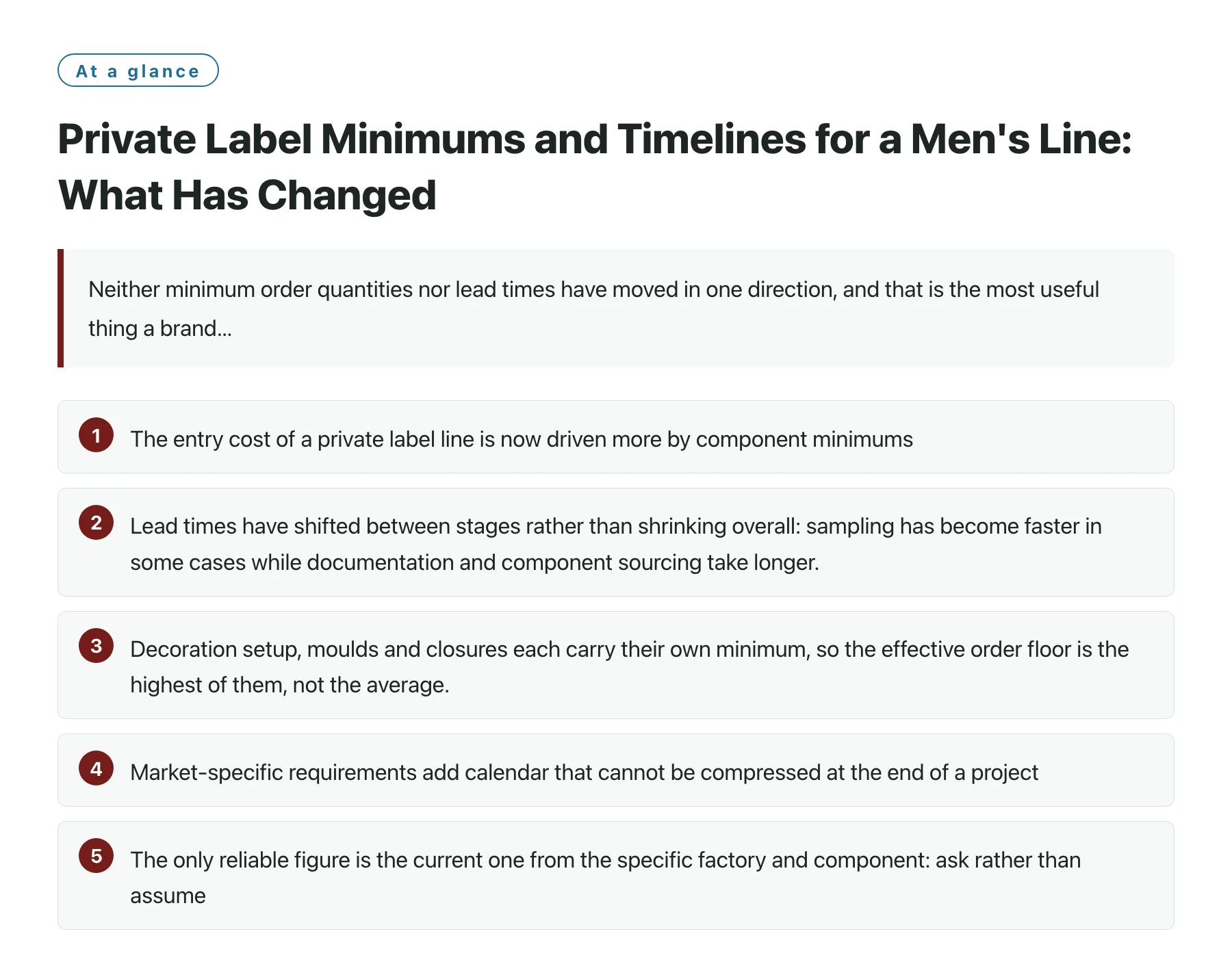
- The entry cost of a private label line is now driven more by component minimums, testing and documentation than by the fragrance volume itself.
- Lead times have shifted between stages rather than shrinking overall: sampling has become faster in some cases while documentation and component sourcing take longer.
- Decoration setup, moulds and closures each carry their own minimum, so the effective order floor is the highest of them, not the average.
- Market-specific requirements add calendar that cannot be compressed at the end of a project, which is why compliance work should run alongside sampling.
- The only reliable figure is the current one from the specific factory and component: ask rather than assume, and write the assumption into the quotation.
Brands that built a fragrance line five or ten years ago often plan the next one from memory. That is where the surprises come from. The structure of a private label project has not changed, but the balance between its parts has, and the change is uneven across categories and markets.
This article describes the shifts worth planning for on a men's line, and the questions that turn a general sense of what has changed into a specific calendar.
What actually moves a minimum or a lead time
A private label minimum is not one number. It is a stack: the component minimum for the bottle, the minimum for the closure, the setup quantity for the decoration method, the smallest batch the filling line can run economically, and the quantity the testing regime needs. The effective floor is the highest of those, which is why two suppliers can quote very different entry volumes for what sounds like the same product.
Component minimums, not fragrance minimums
Fragrance concentrate is the easiest part of the stack to scale down; a compound can be made in small quantity without much setup. Bottles and caps cannot. A stock component may have a low minimum and a long delivery, while a custom moulded one inverts both. When a brand says its minimum went up, the usual cause is a pack decision rather than a change at the factory.
Documentation and market rules add calendar
Regulatory preparation has become a larger share of the timeline in most export markets. In the European Union the principal obligations attach to a responsible person established in the Union, along with a product information file that has to be available to authorities, which means the identity of that person and the assembly of that file are project tasks rather than formalities [1]. The requirements are not the same everywhere: Health Canada's cosmetic pages set out that market's own notification and labelling expectations, and a supplier used to one regime may need to be walked through another [2].
None of this compresses well at the end. A file assembled in the last two weeks before shipping is a file with gaps, and gaps are what turn into a delayed launch.
Four shifts a men's line should plan for
| Item | What buyers used to assume | What to plan for now | Why the change matters |
|---|---|---|---|
| Entry volume | One number applies to the whole order | The floor is set by the highest component or setup minimum in the stack | Brands underestimate entry volume by anchoring on the filling run instead of the pack |
| Sampling speed | Sampling is the slowest stage | Sampling can be quick, while component and decoration preparation is the long pole | Calendar planning based on the old assumption leaves no slack where it is needed |
| Decoration setup | Decoration is a per-unit cost only | Setup quantity and tooling lead time are part of the entry decision | Choosing a decoration method late can push the whole schedule |
| Compliance work | Paperwork follows production | Documentation, labelling text and responsible-person arrangements run in parallel with sampling | Sequential planning is the most common avoidable cause of a missed launch window |
| Second order | A repeat order is faster than the first | A repeat is faster only if the reference standard and the component supply were secured at the first run | Continuity is designed into the first order or not at all |
Read the table as a set of planning assumptions rather than as a forecast. The exact numbers differ by component, category and market, which is why the next section is about questions rather than figures.
How to plan a men's line against moving minimums
The practical response is not to chase the lowest minimum but to remove the parts of the stack that carry the most setup, then to spend the saved money where the customer can perceive it.
Three moves do most of the work.
Standardise the pack, differentiate the finish
A stock heavy bottle with one strong decoration step avoids mould cost and mould lead time while still reading as a serious men's product. The perceived quality of a men's line is carried more by weight, finish and closure feel than by an unusual silhouette.
Get the current number in writing
Ask for the minimum for each element separately — bottle, closure, decoration setup, filling run, testing — and for the delivery time of each. A supplier that can answer item by item has a real cost model; one that answers with a single figure is guessing, and the guess usually moves after the order is placed.
Build the reorder into the first order
Secure the retained reference, confirm how the component is re-sourced and ask what notice a change would require. Private label work is repeat work, and a programme that runs development and filling under one roof, such as private label fragrance manufacturer operations in Guangzhou, can usually plan the first and second runs together. Whether the factory also handles the pack is worth asking early, because their OEM/ODM manufacturing services may cover bottle sourcing as well as filling, which collapses two of the minimums into one conversation. It is also worth reading how a factory describes capacity and repeat production in public, since that is where capacity and quality in private label perfume is normally discussed.
None of this guarantees a shorter calendar. It does mean the calendar is built from numbers that exist rather than from an expectation formed several years ago.
One habit separates brands that launch on time from brands that do not: they write the assumptions into the quotation. If the unit price depends on a first order of a certain size, a decoration method and a named component, all three should appear next to the number. When any of them changes later, the effect on the price and the date is visible immediately instead of arriving as a surprise invoice.
Sources
- European Commission: Cosmetics in the EU —— The European Commission's overview of EU cosmetics rules, including the responsible person, product information file and safety report requirements.
- Health Canada: Cosmetic Safety —— Health Canada's cosmetics pages, covering cosmetic notification, the ingredient hotlist and safety requirements for cosmetics sold in Canada.
Frequently asked questions
Has the minimum order quantity for private label perfume gone up?
It has moved in both directions depending on the component and the format. The reliable approach is to ask for the minimum of each element separately, because the effective floor is set by the highest one rather than by the fragrance.
Why do lead times feel longer than they used to?
Often because more of the calendar now sits in component sourcing, decoration setup and documentation than in the sampling stage. Planning sequentially — sample, then pack, then paperwork — is the most common cause of a compressed final month.
Can a smaller first order be produced for a men's line?
Sometimes, at a higher unit cost and with fewer pack options. The way to reduce the entry volume is to reduce the number of setup steps rather than to negotiate the filling run, which is rarely the binding constraint.
Do I need a responsible person in the EU before I order?
The obligations for the EU market attach to a responsible person established in the Union, so the arrangement has to be in place before the product is placed on the market. Confirm it early with the manufacturer and with whoever will hold the role.
What should be in the quotation besides the price?
The volume assumption, the named components, the decoration method, the delivery window and what happens if any of those changes. Those five items are what make a quotation usable as a planning document.
The best product decisions are no longer the loudest in the room — they are the most evidenced.— Obivu Research Note, 2024
See your own customer signals, ranked.
Turn fragmented interviews, tickets, and verbatims into a single feed of validated insights. Full feature access, white-glove onboarding, no credit card.